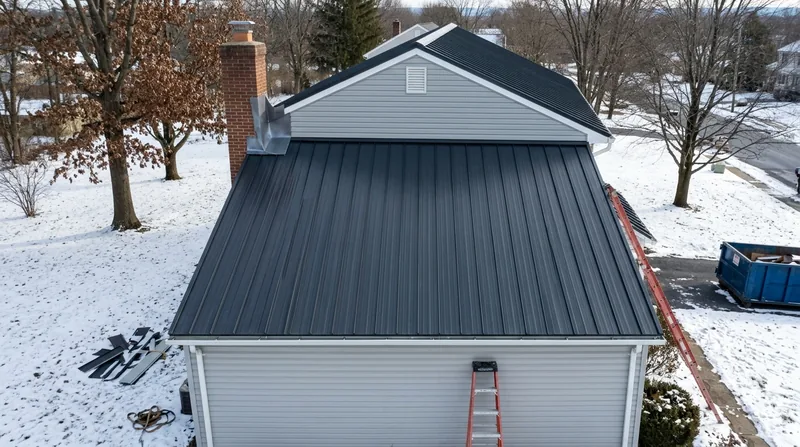




Standing Seam Metal Roofing in Allentown: Built for Lehigh Valley Weather
If you own a home in Allentown, you already know what the Lehigh Valley does to a roof. Snow piles up on the north slope, ice dams form at the eaves, nor'easters drive rain sideways, and summer thunderstorms hammer the shingles from June through August. Standing Seam Metal Roofing in Allentown is the system that handles all of it without exposed screws to back out or granules to wash into your gutters. We roll-form panels to the exact length of each roof run, then mechanically seam them at the ribs so the fasteners stay hidden under the metal.
That matters on the brick Victorians in Old Allentown, the Arts and Crafts homes in the West End, and the post-war twins out in Whitehall. Each one has its own pitch, its own valleys, and its own ice-dam history. A concealed-fastener roof gives you a smooth surface that sheds snow instead of letting it catch and build. If you are weighing this against a full tear-off, start with our metal roof installation in Allentown page to see how the whole assembly goes together.
Why Standing Seam Makes Sense on Allentown Roofs
Allentown sits between South Mountain and Blue Mountain where the Lehigh River cuts through, and that geography funnels cold air down into the valley. The result is freeze-thaw cycling that punishes any roof with a fastener penetrating the surface. On an exposed-screw panel, every screw is a potential leak once the neoprene washer dries out. On standing seam, there is nothing to back out. The panels float on clips that allow thermal movement, so a 20-degree February morning and a 95-degree July afternoon do not tear the seams apart.
- We hide every fastener under the panel, so there are no washers to crack and no screws to re-torque.
- We seam the ribs with a mechanical seamer that folds the metal closed, which keeps wind-driven rain out during a nor'easter.
- We install panels with a smooth finish that lets snow slide, which cuts down on the ice dams that form on the slate mansards around Old Fairgrounds.
- We use Kynar 500 finishes that hold color through Lehigh Valley UV and acid rain without chalking.
- We detail the valleys and eaves with matching metal so water has a clean path to the gutter instead of soaking the fascia.
On the 1870s brick rowhouses and twins, the win is often a slate-look panel that satisfies the historic look without the weight and maintenance of the original slate. Before any work starts, check what the City of Allentown requires for your address at the City of Allentown official site, since permit thresholds and historic review rules vary block by block.
Key info: A homeowner on a 1920s twin near the Old Fairgrounds had ice dams every February that rotted the eave boards. We replaced the rear slope with standing seam panels and added snow retention above the entry. Two winters later, the ice stopped forming because the snow could no longer sit and refreeze at the gutter line.
How We Install Standing Seam on a Lehigh Valley Home
Every job starts with a roof measurement, not a guess. We check the deck condition, the rafter spacing, and the chimney and skylight details before we order a single panel. Panels are roll-formed to length on site or at the shop, so there are fewer horizontal laps where water can find a way in. On the steep pitches common in the West End, we set staging and roof jacks so the crew can work safely and the panels do not get oil-canned from being walked on.
- We strip the old roofing down to the deck and replace any soft sheathing we find.
- We install an ice-and-water shield at the eaves and in the valleys, then a synthetic underlayment across the field.
- We set the eave trim and the concealed clip system, spacing clips to the panel manufacturer's wind rating.
- We roll or lift the panels into place and mechanically seam every rib from eave to ridge.
- We install the ridge cap, the rake trim, and the pipe boots, then seal the penetrations with matching metal.
- We walk the roof, check every seam and termination, and clean the gutters before we pull off the job.
For homes in Emmaus or Macungie where the roof plane runs long and low, we often combine the standing seam field with new gutters sized for the higher runoff. Our gutter installation for metal roofs page covers how we hang hangers and size the trough for a metal roof's faster flow.
Key info: A 1990s colonial in Lower Macungie had two valleys and a low-slope porch roof that kept leaking at the shingle transition. We ran standing seam panels up the main slopes and tied the porch roof in with a soldered valley pan. The homeowner has not called us back for a leak since.
Standing Seam Profiles and Options We Install
Not every standing seam roof is the same. The panel profile, the seam height, and the metal gauge all change how the roof performs on a given pitch and how it looks against the brick or stone of a Lehigh Valley home. Here is how we match the approach to the house.
| Approach | Description | Best for |
|---|---|---|
| Snap-lock standing seam | Concealed clips, panels snap together at the rib without a mechanical seamer. | Residential roofs with standard pitches and moderate wind exposure. |
| Mechanically seamed panels | Double-locked ribs formed with a power seamer for a tighter, stronger seam. | Exposed ridges, long runs, and homes on open ground near South Mountain. |
| Slate-look standing seam | Panels with a textured finish and a profile that mimics the original slate. | Victorian and Tudor homes in Old Allentown and the West End. |
| High-rib commercial profile | Taller ribs and heavier gauge for longer spans and higher wind uplift ratings. | Barns, shops, and commercial buildings across Lehigh and Northampton counties. |
| Standing seam over existing shingles | A retrofit with a sub-frame or purlin system when the deck can take it. | Homes where the existing roof has just one layer and the budget favors a recover. |
Each profile changes the panel width, the clip spacing, and the trim package, so we settle the choice before we order metal. That is also the point where we confirm the color against the existing brick or stone.
Standing Seam Metal Roofing Cost in Allentown: What to Expect
Homeowners ask for a number before anything else, and that is fair. Standing seam pricing starts at From $10 per square foot installed for a straightforward residential roof. That figure moves with the panel profile, the metal gauge, the number of valleys and penetrations, and how much tear-off the job needs. A simple gable on a Whitehall ranch sits at the low end. A West End Tudor with three dormers, two valleys, and a chimney chase sits well above it.
- Roof size and pitch drive the panel count and the labor hours more than any other factor.
- Access matters: a narrow rowhouse lot in Old Allentown needs different staging than a wide suburban lot in Lower Macungie.
- Tear-off and deck repair add cost when the old roof has multiple layers or soft sheathing.
- Complexity from dormers, skylights, and chimneys adds trim work and flashing time.
- Panel finish and color selection can shift the material price by a noticeable margin.
Get two or three written estimates and compare the scope line by line, not just the bottom number. Our full pricing overview breaks down what sits inside a standing seam quote so you can spot a low bid that leaves out ice-and-water shield or clips.
Standing Seam Metal Roofing Near Me: How to Pick a Contractor Near Allentown
You will see plenty of trucks with a ladder rack and a phone number. The difference between a roof that lasts 50 years and one that leaks in year three is the crew that installs it. Ask for the contractor's license and insurance certificate, and call the number on the certificate to confirm it is current. Ask for addresses of standing seam roofs they have done in the Lehigh Valley, then drive past them and look at the seams and the trim.
- Confirm the contractor carries liability and workers' compensation coverage before anyone gets on your roof.
- Get at least three written estimates that list the panel brand, the gauge, and the underlayment by name.
- Ask whether the crew mechanically seams the ribs or only snaps the panels together.
- Check whether the company pulls the permit and schedules the inspection, or leaves that to you.
- Ask how they handle historic district or HOA approval if your home is in a review area.
We are a Metal Roofing Alliance member and we carry the insurance and licensing that Lehigh Valley municipalities expect. When you are ready to talk through your roof, contact us for a free estimate at (610) 600-9879 and we will set a time to measure.
Standing Seam Metal Roofing in Allentown: Pricing Guide
| Service | Price | Details |
|---|---|---|
| Standing seam, standard residential pitch | Starting at $10/sq ft | Includes panels, clips, underlayment, and trim on an accessible roof with a simple layout |
| Slate-look standing seam | Starting at $14/sq ft | Textured finish and profile for Victorian and Tudor homes, priced higher for material and detail work |
| Complex roof with dormers and valleys | On estimate | Dormers, chimneys, skylights, and multiple valleys add trim and flashing time that needs a site visit |
| Tear-off and deck repair | Quoted per layer | Removing old shingles and replacing soft sheathing is priced by the square and the extent of damage |
| Travel | Included | In Allentown and the surrounding Lehigh Valley, with no separate call-out or mileage fee |
| Estimate | Free | Response within 24 hours at (610) 600-9879, with no obligation to book the work |
Indicative pricing, the exact cost depends on square footage, finish, and site access. Free personalized estimate within 24h at (610) 600-9879.


